Flashback Friday: Bike EXIF’s Top 10 Ducati Motorcycles of 2024
There is a distinct art to reshaping Italian desmodromic soul. While some manufacturers yield to predictable customization formulas, Ducati has always demanded something more: a respect for its racing lineage, a sharp eye for its trellis geometry, and an absolute obsession with weight. In 2024, the builders who graced our pages threw out the cookie-cutter templates to deliver everything from superbike-powered modern classics to radically re-engineered air-cooled monsters.
Today, we are counting down the top ten custom Ducatis from 2024 that stopped us in our tracks, dominated our traffic, and redefined what is possible with a donor from Borgo Panigale.
Special edition motorcycles were once truly special, and few hold the legendary status of the Ducati 900 MHR (Mike Hailwood Replica). When Benjie’s Café Racers (BCR) was commissioned to customize a rare 1985 MHR Mille, one of only 1,100 units built, they ignored the cries of purists to save a neglected, faded machine that had suffered a poor 90s restoration. Benjie Flipprboi and his team set out to transform the blocky, 80s sportbike into a contemporary, streamlined masterpiece inspired by Pierre Terblanche’s iconic MH900e.
To achieve this, BCR retained the unmistakable overall shape of the original MHR tank but modified its dimensions, building a carbon-fiber outer shell that conceals an aluminum fuel reservoir beneath. The carbon-fiber tail section was shaped to mimic the tank’s lines, resting on a sharp, aggressive stainless-steel trellis subframe. BCR discarded the original twin-shock rear end, choosing instead to widen and brace the swingarm to accept a modern monoshock, while swapping the outdated front suspension for Showa inverted forks.
The rolling gear was updated with ultra-lightweight BST carbon fiber wheels wrapped in Michelin Pilot Street Radial rubber and stopped by modern twin-disc brakes. Up front, a narrow, custom carbon fiber fairing flows seamlessly into the tank, held in place by classic stays and featuring an aluminum-bezel headlight. Fed by a pair of burly FCR carburetors, the L-twin motor now exhales through a custom, asymmetrical twin exhaust made from pie-cut stainless steel. Finished in raw carbon fiber with classic MHR-inspired green and white graphics, this build is a flawless, highly elevated reimagining of a rare classic. [MORE]
While Ducati’s Imola 200 victory in 1972 is legendary, the production model that bridges the gap between the touring 750 GT and the subsequent desmo 750 Super Sport is the incredibly rare 1972 Ducati 750 Sport. Designed by Leopoldo Tartarini, this model featured a non-desmo valve train to manage production costs, but boasted a higher compression ratio, twin front brakes, and large Dell’Orto PHF32A carbs. Because so many genuine 750 Sports have been faked using standard 750 GT donors, finding an authentic first-edition ‘Z Stripe’ is a monumental event for vintage motorcycle collectors.
This particular machine, verified by renowned historian Ian Falloon as one of only 300 genuine examples produced in 1972, underwent an obsessive, museum-grade restoration by Belgian collector Achim Gier. Achim spent years hunting down period-correct components, even replacing an incorrect 1974 Borrani rim with an authentic 1972-coded hoop. The engine was completely rebuilt, the cases aqua-blasted, and the original Marzocchi forks and Scarab brakes meticulously restored to functioning order, alongside the original fiberglass fuel tank and tail section.
The rare factory-accessory front fairing was mounted with authentic hardware, while the striking black-and-yellow ‘Z Stripe’ paint scheme was precisely matched to new-old-stock components in Achim’s inventory. This exceptional machine is a rolling time capsule that preserves a vital, brief era of Ducati’s early superbike history, with a level of authenticity that makes it one of the most original examples left. [MORE]
The Ducati SportClassic remains a benchmark for modern factory cafe racers, but architect Lucas Worthing wanted to pair its timeless looks with raw, modern superbike power. Specifically, he wanted to harness the 170-horsepower desmodromic L-twin engine of a late-2000s Ducati 1198 SP. Rather than attempting a clumsy engine swap on an original SportClassic, Luke purchased the frame, engine, and swingarm of an 1198 SP, and collaborated with StradaFab in Kansas to build a custom titanium trellis frame from scratch.
Luke drew on his structural engineering background to design a hybrid titanium trellis frame capable of handling the torque of the 1198 motor while accommodating the SportClassic’s bodywork and central rear shock. An aluminum fuel tank had to be heavily modified, moving its internal fuel pump plate inboard to clear the top mount of the rear Öhlins shock, while the airbox was narrowed to fit the frame’s tighter lines. A SportClassic Monoposto carbon fiber tail section was fitted, neatly housing the battery in the rear hump.
To match the high-end chassis, the hybrid was fitted with Showa front forks, BST carbon fiber wheels, and full Brembo brakes. StradaFab fabricated a titanium dash mount to hold the digital superbike instruments behind a Speed Moto Co. headlight, while NCR titanium rear-sets and a custom titanium coolant overflow tank were added. Dressed in a coat of Porsche Oak Green Metallic paint with subtle racing stripes, this 170-horsepower monster is a stunning marriage of classic style and superbike performance. [MORE]
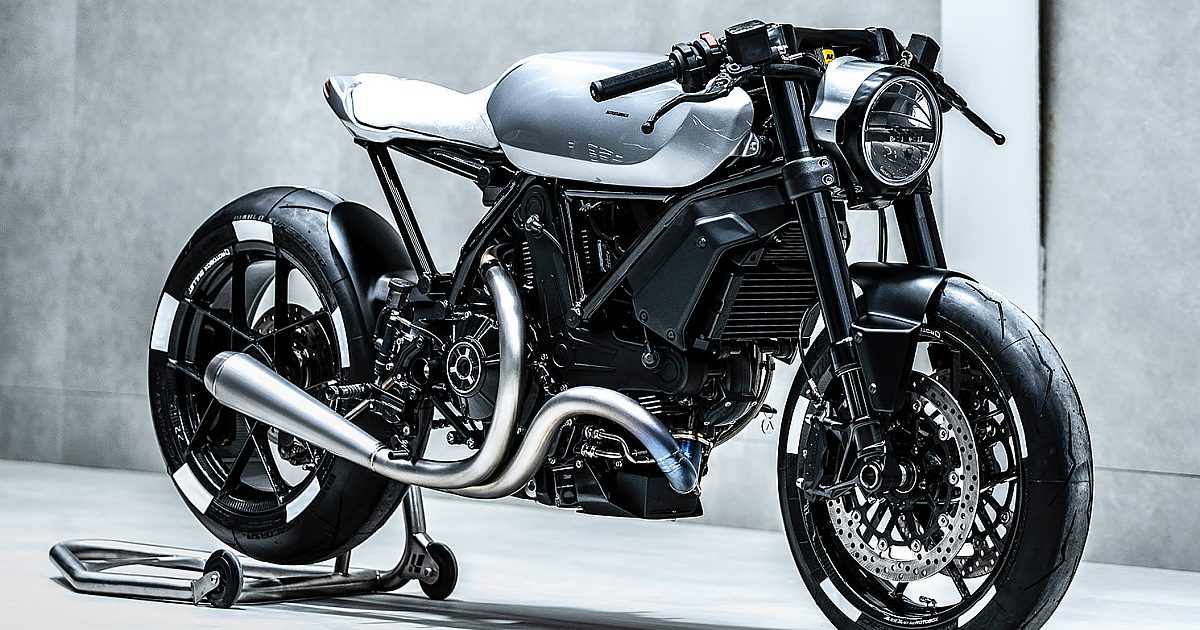
England’s Auto Fabrica has built a stellar reputation by treating motorcycles as high art, producing flowing, concept-bike silhouettes that remain highly functional. For their first-ever Ducati build, dubbed the ‘T23,’ founders Bujar and Gaz Muharremi started with a 2024 Ducati Scrambler 1100 Pro. The simplicity of the air-cooled L-twin, combined with the stock bike’s Öhlins suspension and Brembo brakes, provided the perfect canvas for the brothers to explore their signature integrated bodywork design.
Auto Fabrica began by lowering and blacking out the front forks, before grafting on a single-sided swingarm from a Ducati Hypermotard 821. The bike rolls on carbon-fiber wheels from Rotobox, shod in Pirelli Diablo Supercorsa tires, detailed with custom white accents that emphasize the split-spoke design. The rear subframe was completely lopped off and replaced with a custom tubular unit designed to support a one-off, hand-formed aluminum monocoque shell that combines the tank, tail, and a removable seat cover.
The removable aluminum seat cover gives the bike a dual personality, clinging to its sculpted, stationary concept look when parked, but easily sliding off to reveal a rich, padded suede seat for riding. The cockpit features integrated clip-ons on a custom top yoke, knurled aluminum grips, and a relocated factory digital dashboard. Completed with a silver paint job and a gorgeous, hand-formed titanium exhaust system that sweeps tight against the L-twin, the T23 is an incredibly light, usable piece of rolling sculpture. [MORE]
Shiro Nakajima of 46Works is highly celebrated for building understated, high-performance restomods from his workshop in the foothills of the Yatsugatake Mountains. For this commission, Shiro selected a 1994 Ducati Monster M900, intending to build a B-road weapon with a classic 1970s race bike aesthetic. Finding the stock Monster’s chassis geometry slightly too rigid for public mountain passes, Shiro heavily re-engineered the trellis frame, reducing lateral rigidity and moving the neck forward by 10 mm.
He suspended the front end with Ceriani GP replica forks mounted to custom-machined triple trees, and modified the rear swingarm to accommodate a custom Öhlins shock. To capture a vintage look, Shiro ditched the modern 17-inch alloy wheels in favor of 18-inch wire-spoked rims laced to modified Yamaha hubs, wrapped in classic Dunlop TT100 GP rubber. The bodywork is a tour de force of hand-beaten aluminum, designed to maintain a low, horizontal line that mimics classic racers without compromising the bike’s stock seat height.
The rebuilt L-twin engine features Keihin FCR carburetors, a Setrab oil cooler, and beautiful, custom-cut aluminum belt covers. Shiro finished the build with a custom-bent 2-into-1 titanium exhaust system that exits through a single handmade titanium muffler, specifically routed to allow oil changes without removing the pipes. To preserve the raw, unputtied aluminum finish of the tank and tail, Drops Design Works applied only clear coat, vintage graphics, and a period-correct Ducati logo, resulting in a magnificent, lightweight racer. [MORE]
The underappreciated Ducati 750 SS might have an awkward stock profile, but Chiel Nipius of Dutch workshop Nius Moto saw past the factory plastic to focus on the Italian trellis frame underneath. Having cut his teeth working under Arjan van den Boom at Ironwood Custom Motorcycles, Chiel went solo and built this streetfighter-inspired cafe racer. He stripped the 2002-model donor of its bulky fairings, retaining only the deeply contoured fuel tank, and chose to refurbish the factory Marzocchi forks, Sachs shock, and Brembo brakes to keep the budget sensible.
Chiel coated the wheels and rear spring in dark anthracite powder coat, painted the Brembo calipers, and fitted sticky Pirelli Diablo Corsa tires. He deleted the stock airbox in favor of foam filters and focused his fabrication skills on a pie-cut stainless steel exhaust system. The headers wrap around the L-twin engine, cross over, and exit through high-mounted aftermarket mufflers that flank a custom, skeletal trellis rear subframe.
To maintain a clean aesthetic, Chiel relocated the extensive wiring harness into a series of custom-fabricated covers hidden directly under the fuel tank. The front end features a handmade aluminum fender and a custom headlight nacelle holding a Highsider LED headlight, secured by a custom bracket bolted to both yokes. Finished in a Porsche grey paint scheme with a bronze metal-flake frame and automotive-inspired seat stitching, this build is a masterclass in clean customization. [MORE]
When a client brought a 2016 Ducati XDiavel S to Vietnam’s MFix Workshop, he wanted to pay homage to Ducati’s drag-inspired ‘draXter’ concept. To drastically alter the cruiser’s stance, the shop replaced the stock rear suspension with an Öhlins shock from a Kawasaki ZX-10R, designing a custom CNC-machined linkage and titanium axle to fit. In the most radical ergonomic change on our list, the foot pegs were relocated from their cruiser-like forward position to a sporty layout alongside the rear wheel hugger.
Low-slung clip-on handlebars replaced the stock riser bars on a custom billet aluminum top yoke, which also houses a relocated digital dashboard. Performance was upgraded with Brembo calipers cooled by carbon-fiber air ducts, a CNC Racing dry-clutch conversion, and a custom-fabricated titanium exhaust system that exits ahead of the rear wheel. The bike was fitted with high-end carbon fiber components, including a front fender, radiator cover, belly pan, and passenger seat eliminator.
However, the build took a wild turn when the client requested a design that looked like a Harley-Davidson V-Rod. MFix spent four months prototyping and machining a set of custom aluminum engine covers that mimic the V-Rod’s beefy case covers, complete with «no fake sh*t» engraved on them. Finished with an authentic V-Rod headlight from HogLights, this «Duca-Rod» is an incredibly bizarre, beautifully machined, and delightfully ironic custom. [MORE]
The original Ducati Monster, penned by Miguel Galluzzi in the early 90s, is one of the most iconic naked bikes in history, and Moscow-based Vlad Aysin spent seven years building the ultimate tribute to it. Vlad treated his 1999 Monster 900S to a slow-burn restomod, rebuilding the engine with high-compression Fast by Ferracci pistons, a lightened Kämna flywheel, and a Tamburini oil cooler. The L-twin now inhales through a Ducati Performance open intake and screams through a titanium SilMotor exhaust system with dual carbon fiber under-seat mufflers.
The running gear was heavily upgraded, starting with inverted Öhlins forks from an Aprilia RSV held in Ima Special Parts triple trees. A beefy Metmachex Engineering alloy swingarm with eccentric axle mounts sits out back, suspended by an Öhlins rear shock. Vlad assembled a high-spec Brembo brake system using calipers from a Ducati 999, floating discs from a 996, and a KTM motocross rear master cylinder with an integrated reservoir to keep the packaging clean.
The cockpit was updated with Brembo master cylinders on tapered bars, an Aviacompositi digital dash, and an adaptive LED headlight in a custom carbon fiber housing. Vlad added an EVR slipper clutch, Aviacompositi carbon belt covers, and a Sargent seat behind the stock fuel tank, which was fitted with TechSpec tank pads. Finished in a deep black metallic flake on the tank, frame, and original three-spoke wheels, this Monster is a wonderfully aggressive, highly refined street weapon. [MORE]
Before Ducati abandoned the trellis frame on its modern naked line, the liquid-cooled Monster 821 was an incredibly balanced, aggressive package. Jérémie Duchampt of France’s Jerem Motorcycles decided to amplify the bike’s inherent brutality with a custom build nicknamed ‘Icon.’ Jérémie kept the stock fuel tank but completely fabricated a compact, trellis-style subframe that was welded directly to a custom-designed, scooped seat pan upholstered in dual-texture fabric by Yaya Brush Sellerie.
A pair of aftermarket mufflers exit directly under the tail cowl on custom connector pipes, paying direct homage to the iconic under-seat exhausts of first-generation Monsters. To elevate the running gear, Jérémie retrofitted a single-sided swingarm and wheels from a Monster 1200S, which required custom machining to align with the 821’s chassis. The stock forks and Brembo brakes were completely rebuilt, anodized in black, and shod in sticky Pirelli Diablo Supercorsa tires.
The engine received a Ducabike hydraulic clutch conversion, a CNC Racing clutch slave cylinder, and carbon fiber covers. Up front, a handmade aluminum fender and custom belly pan are paired with an LED headlight and Kellermann turn signals. The bike’s striking livery features a deep Alpine Blue paint on the tank, subframe, and forks, contrasted against a gold-powder-coated trellis frame and a blacked-out powertrain, creating an incredibly bold and modern streetfighter. [MORE]
Topping our list for 2024 is Gas & Oil Bespoke Motorcycles of Prague, who built a jaw-dropping, neo-retro cafe racer using a 2007 Ducati Monster S2R 1000. Shop boss Matěj Sysel wanted to preserve the S2R’s excellent factory components, including the single-sided trellis swingarm, five-spoke rear wheel, and dual Brembo brakes, while completely discarding the bulbous stock plastics. In their place, the team sculpted an aluminum fuel tank and a matching, scalloped cafe racer tail cowl.
The custom seat pan features a clever lower lip that traces the frame lines, perfectly hiding the regulator/rectifier, and is topped with a beautiful brown leather saddle. Gas & Oil fabricated a custom, lightweight trellis subframe, an abbreviated front fender, and a custom bracket to mount a Koso LED headlight directly to the bottom yoke. The top yoke was stripped of its handlebar clamps to host low-slung clip-on bars equipped with a Motogadget digital speedometer, bar-end turn signals, and mirrors.
The air-cooled 992cc L-twin was treated to exposed cam belts, CNC Racing foot controls, and a hydraulic clutch, with the stock airbox deleted in favor of Uni Filter pods. The exhaust is a work of art; hand-formed stainless steel headers wrap around the engine block before merging and exiting through a high-mounted Sharon muffler. Dressed in a classic, high-contrast gloss-black-and-gold paint scheme with retro Ducati tank logos, this build represents the absolute pinnacle of modern desmodromic cafe-racer design. [MORE]
Bike EXIF is the world’s leading custom motorcycle website. We showcase the best custom bikes from around the globe, along with the latest news, reviews, and features.
You said some things, we said some things, but we miss the banter. Comments are back. Join the discussion with your Bike EXIF account.
Are you leaving before you sign up for our newsletter?
Nota original publicada en el portal de bikeexif.com el 4 de septiembre de 2026: https://www.bikeexif.com/bike-exifs-top-10-ducati-motorcycles-of-2024.
#MotociclismoyRocknroll #Motociclismo #Rocknroll #Motos #Musica #Siguenos